
Science and Islam: A Quranic Perspective for Modern Minds
Does Islam Conflict with Reason?
The relationship between science and religion has always raised important questions. Some
people see a conflict between them, while others believe they work together in harmony.
Islam presents a balanced view that encourages knowledge, reflection, and understanding.
This topic has always occupied the attention of thinkers and religious scientists. Some describe
the relationship between science and religion as a kind of conflict, and others describe it as a
kind of harmony. However, with the coming of Islam, the path began to move towards a less
tense and more stable form, as Islam views them positively, because Islam is a religion that
calls for science. This is what we see in many Ayat (verses) of the Quran that support this
complementary relationship based on the principles of knowledge, interaction,
communication, and respect for specializations. And this is what we will present in this article
to arrive at the truth of this disagreement and see whether the claims are true or false.
❖ The Quranic Encouragement of Scientific Inquiry and Contemplation
upon the Universe
All praise is due to Allah. Allah, who created humankind and appointed them as His
successor on Earth, commanded them to cultivate it through righteousness and to refrain from
corruption. The first thing He commanded them to pursue on their earthly journey was
knowledge. Our Islamic faith calls for learning and reflection, and the first Ayah (verse)
revealed to the Prophet Muhammad (peace be upon him) was: “Read! In the Name of your
Lord who has created (1) He has created man from a clot (2) Read! And your Lord is the Most
Generous (3) Who has taught by the pen. (4) He has taught man that which he knew not.
(5)”. {Surat Al-Alaq}. The Quran encourages scientific research and contemplation of the
universe, Allah Almighty has called upon us to think; to think about everything in the universe,
creation, and the self, and even taking lessons from those who came before us, as Allah said
in Surat Ar-Rum: “Do they not think deeply about themselves? Allah has created not the
heavens and the earth, and all that is between them, except with truth and for an appointed
term. And indeed, many of mankind deny the Meeting with their Lord. (8).” {Surat Ar-Rum},
Allah also urged us to think on the creation of man himself, as He said in Surat Az-Zariyat: “And
also in your own selves. Will you not then, see? (21).” {Surat Az-Zariyat}. Thus, we see that
the Quran which was revealed to our Prophet Muhammad (peace be upon him) came to teach
people about their religion and their world. Islam did not come to destroy beneficial aspects
of knowledge, but rather to correct and complete it. The Quran also appreciates the value of
knowledge because it is a revelation from Allah, and Allah knows best about the matters of
His servants, and this is supported by the Quran and Sunnah, as stated in hadith Abu Dawud:
“The superiority of the scholar over the worshipper is like that of the moon on the night
when it is full over the rest of the stars. And indeed, the scholars are the heirs of the
prophet…” (Abu Dawud). For that, scientists are considered the heirs of the prophets because
of the knowledge they carry, and through the Quran, Allah encourages us to learn and reflect
on everything.
❖ Integration of Reason and Revelation in Human Civilization
If we want to find the reason for the progress of nations, we find that it is due to
knowledge, so we can see its effect materially as we see it on our minds and the development
of our ideas. For example, until recently scientists used to believe that the stage of the Muscle
development (Myogenesis) in the embryo precedes the formation of bones, then modern
science proved that bones are formed first, then flesh; and we find that Quran stated this
more than one thousand four hundred years ago where Allah mentioned the stages of embryo
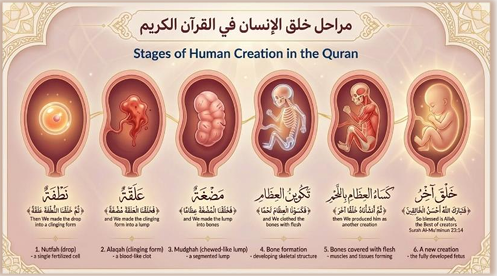
formation, in His saying: “And indeed We created man out of an extract of clay (12)
Thereafter We made him in a safe lodging (13)Then We made the Nutfah into a clot, then
We made the clot into a little lump of flesh, then We made out of that little lump of flesh
bones, then We clothed the bones with flesh, and then We brought it forth as another
creation. So Blessed is Allah, the Best of creators. (14).” {Surat Al-Mu’minun}. In this Ayah
Allah first spoke about the origin of humankind, our father Adam, peace be upon him, stating
that he was created from clay, and modern science has also confirmed that the components
of humankind also from the elements of the soil, then Allah informed us that He placed him
in a secure place, and spoke in detail about the stages of his creation, including the fact that
the bones were created before the flesh. This is what science considers this is one of the
miracles of the Holy Quran. What we want to say is that science may hold a certain belief
based on recent scientific experiments, and then it turns out to be the opposite, so how can
we be 100% sure, especially regarding matters that humankind had nothing to do with creation
from the beginning? And this does not mean we ignore reason; on the contrary, reason is the
means by which humankind understands the true nature of things and sciences, leading them
to know Allah, the Creator of the universe. The more one learns about Him, the more one’s
faith in Him and His creation grows. Thus, we find that religion has refined science, guided
scientists, and set limits for science, preventing its misuse for harmful or unethical purposes
that might cause damage to humanity. And we have also seen the impact of science on the
development of human civilization, through Muslim scientists who were the first to invent the
idea of infrastructure and the first to introduce street lighting and paving to Europe. And the
Muslim monuments in Andalusia (currently Spain and Portugal) still witness to this.
❖ Scientists who Combined Science and Religion
From the above, we can understand that there is no contradiction between science and
religion, especially if this religion is the true religion, not a false or distorted belief; a belief
that originates from Allah the Creator. Indeed, religion strengthens and confirms science, and
the best evidence of this is that many Muslim scientists were the cornerstone of most modern
sciences, such as medicine, astronomy, and other applied sciences. Before that, they excelled
in the sciences of machines, which they learned and became familiar with for the sake of
religion, and their era was called the Islamic Golden Age, for that religion was their motivation
for learning, and this is what made them the masters of nations when no one else knew
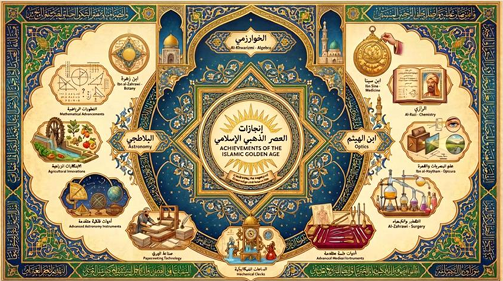
anything about them. And here are some examples of the famous polymaths Muslim
scientists who combined religious and natural sciences, Ibn Sina, who excelled in medicine
and was the author of the book The Canon of Medicine ; Al-Zahrawi, who was the first to write
on surgery; Ibn al-Nafis, the discoverer of microcirculation; Al-Khwarizmi, the founder of
algebra and the basics of algorithms; and Al-Biruni, who was the first to give an accurate
calculation of the Earth’s circumference, and what encouraged those scientists to excel in
these natural sciences was the religious motive and the Quran’s urging of contemplation of
Allah’s universe signs. Muslim scientists did not see a conflict between scientific research and
religious principles, but rather considered them two sides of the same coin: knowing the truth
that leads to faith.
In conclusion, we say that a fair mind and beneficial knowledge are the path to faith in
Allah, and without knowledge and contemplation, humans would not understand Allah’s will
for them, and without revelation, humans would remain lost in their thoughts, unable to find
the right path or be certain of any guidance. Therefore, Allah emphasized on us that we must
continue to learn and observe the signs of Allah, which lead will lead to the ultimate goal,
which is ‘knowing Allah,’ Who He has full knowledge of everything, And this is according to
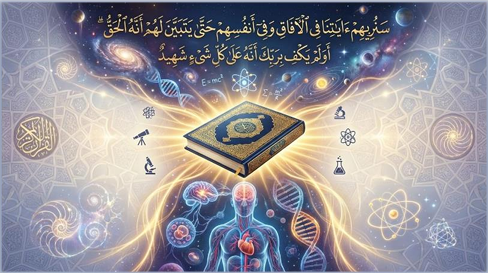
the word of Allah: “We will show them Our Signs in the universe, and in their own selves,
until it becomes manifest to them that this (the Quran) is the truth. Is it not sufficient in
regard to your Lord that He is a Witness over all things? (53).” {Surat Fussilat}.
So, never stop learning, nor stop thinking about the universe around you, until you reach
your ultimate goal, which is Knowing and worshipping Allah.
Take the Next Step in Your Learning Journey
If you are interested in learning the Quran, understanding Islamic sciences, or mastering
Tajweed—especially as a non-Arabic speaker—we invite you to join our interactive study
circles designed for Muslims around the world.
Frequently Asked Questions
Does Islam conflict with modern science?
Does the Quran encourage scientific thinking?
Can a Muslim study science and strengthen faith?
References:
The Holy Quran
Abu Dawud – Sunan Abi Dawud, Hadith on the virtue of knowledge
Al-Daleel Institute – Scientific Reflection in the Quran
Al-Shindagah Magazine – Al-Biruni and Contributions to Science
Alukah.net – The Quran and Scientific Research
https://cohe.uokerbala.edu.iq/wp/%D8%A7%D9%84%D8%B7%D8%A8%D8%A7%D9%84%
D8%A5%D8%B3%D9%84%D8%A7%D9%85%D9%8A%D9%81%D9%8A%D8%A7%D9%84%D
8%B9%D8%B5%D8%B1%D8%A7%D9%84%D8%B0%D9%87%D8%A8%D9%8A%D8%A5%D8
%B3%D9%87%D8%A7%D9%85%D8%A7%D8%AA/?hl=en-US