
There is no single best format. The mosque gives community and belonging, one-to-one lessons give the most recitation time and immediate correction, and group classes sit in between. Many families keep the mosque for community and add one-to-one lessons for recitation, Tajweed and memorization.
When parents start looking for Quran classes, the first question is often not which teacher, but which format: the local mosque or weekend school, a group class online, or one-to-one lessons with a private teacher. Each has real strengths, and the right choice depends on your child, your goal and your week, not on which option is newest.
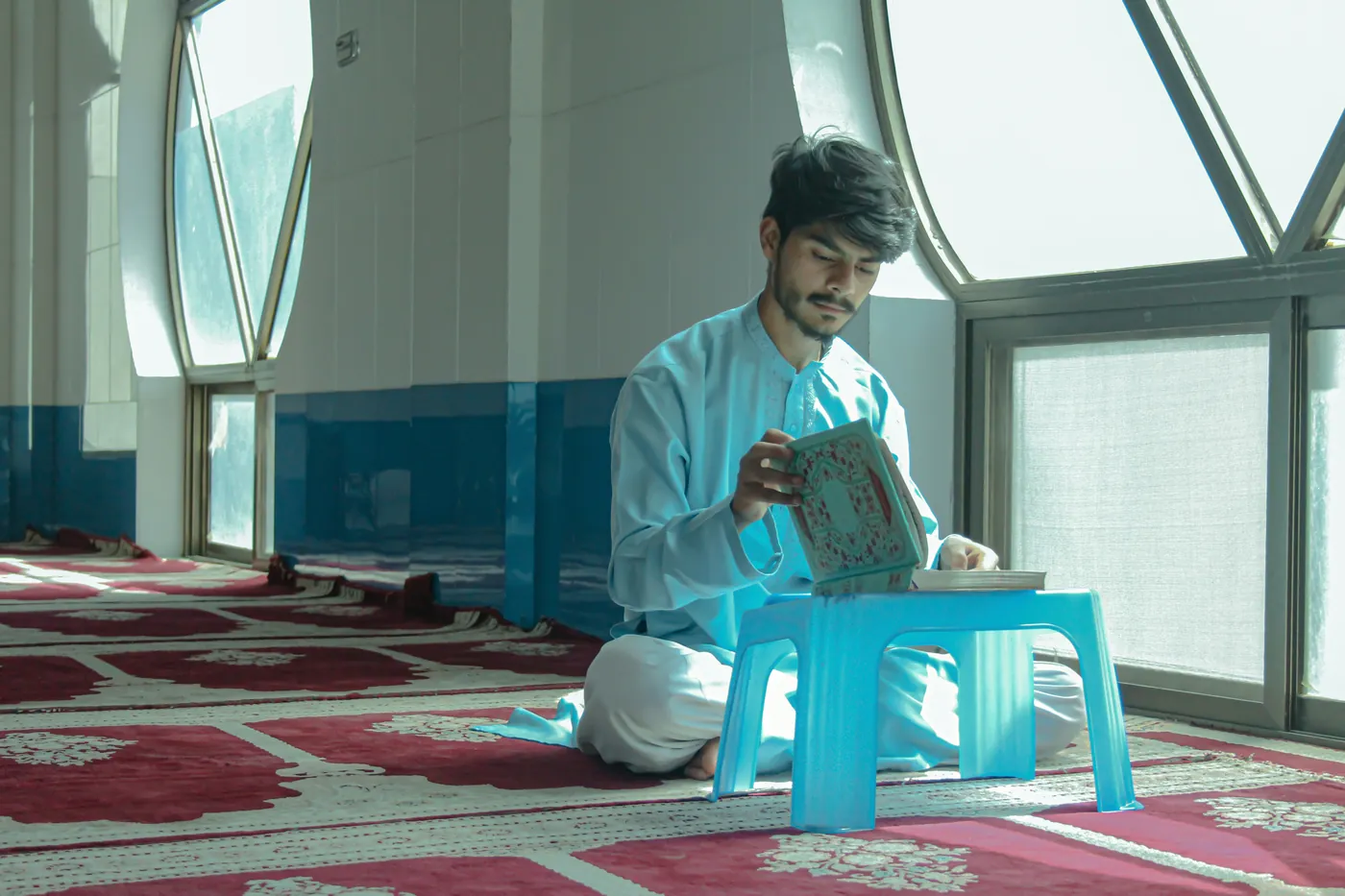
This guide compares the three formats honestly, shows what each does best, explains when families combine them, and lists the questions that help you decide. The religious texts and research it relies on are listed at the end.
The short answer
There is no single best format for every child. The mosque gives community and a living connection to the Muslim community; one-to-one lessons give the most individual listening and correction; group classes sit in between. Many families get the best of both by keeping the mosque for community and adding one-to-one lessons for recitation and memorization.
What the mosque and weekend school offer
Learning the Quran together in a mosque carries a value of its own. The Prophet ﷺ said (meaning): "No people gather in one of the houses of Allah, reciting the Book of Allah and studying it among themselves, except that tranquillity descends upon them, mercy covers them, the angels surround them and Allah mentions them among those with Him" (Sahih Muslim 2699).
- Community and belonging: children see other Muslim children learning, which matters a great deal when they are a minority at school.
- Connection to the imam and the community: the mosque becomes a familiar place, not only somewhere to go on Eid.
- Shared motivation: learning alongside peers can encourage some children to keep going.
The limits are usually practical: travel time, fixed schedules, and less time for each child to recite individually when a class is large. Some children also find long sessions after a full school day tiring.
What one-to-one lessons offer
Education research has long found strong results for one-to-one tutoring. In a well-known paper, Benjamin Bloom reported that students taught one-to-one with mastery-based methods performed far better than students taught conventionally in groups, and framed the challenge of finding group methods as effective as tutoring (Bloom, 1984). A later review of randomized experiments found consistent, substantial learning gains from tutoring programmes (Nickow, Oreopoulos and Quan, 2020).
For Quran learning the reason is easy to see. Recitation is a skill that improves when someone listens and corrects. In a one-to-one lesson:
- the whole lesson is your child's recitation time;
- mistakes are corrected as they happen, before they settle;
- the pace follows the child, not the average of a class;
- scheduling can fit school, time zones and family life.
The limit is that one-to-one lessons do not, by themselves, give the community of a mosque. That is why many families combine them.
Group classes: the middle option
Small group classes, online or in person, can work well for children who enjoy learning with peers and for subjects that rely on discussion, such as stories of the Prophets or Islamic manners. For recitation and memorization, the key question is how much time each child actually recites to the teacher and how often mistakes are corrected individually.
Comparing the three formats
| Question | Mosque or weekend school | Group class | One-to-one lessons |
|---|---|---|---|
| Individual recitation time | Depends on class size | Shared between students | The whole lesson |
| Pace | Set for the group | Set for the group | Set for the child |
| Community and peers | Strong | Some | Limited on its own |
| Scheduling | Fixed times and travel | Fixed times | Flexible, any time zone |
| Correction of each mistake | Depends on the teacher and numbers | Partial | Immediate |
Combining them: what many families do
Choosing one format does not mean giving up the other. A common pattern is to keep the mosque or weekend school for community, prayer and friendships, and to add one-to-one lessons on weekday evenings for recitation, Tajweed and memorization. Children then get both the belonging and the individual correction. Our guide to the best time for online Quran classes when you live abroad helps fit lessons around school.
Signs the current format is not working
Whatever you choose, watch how your child responds over a few months rather than a few weeks. These signs suggest it is time to adjust:
- Your child reads the same mistakes week after week, and nobody seems to notice them.
- Your child rarely gets a turn to recite, or recites only in a chorus with others.
- Lessons have become a daily argument at home, or your child is too tired to take anything in.
- You cannot tell what your child learned last month, because there is no feedback.
- Memorized surahs keep slipping away because there is no revision plan.
None of these is a reason to give up on the mosque or on lessons. They are a reason to change the format, the timing or the amount, or to add individual correction alongside what you already have.
Questions that help you decide
- What is the goal now? Reading correctly, Tajweed, memorization, or a connection to the community?
- How does your child learn best? Some children shine in a group; others need quiet and individual attention.
- How much time does your week really have? Travel time counts.
- How is safety handled? For any online option, ask who supervises lessons and how teachers communicate with children. Our child safety page explains our rules, and our guide on choosing a safe online Quran academy lists the questions to ask.
How our one-to-one lessons work
Our online Quran classes for kids are one-to-one and live, with teachers who are graduates of Al-Azhar Al-Sharif. A Quality Supervisor follows every class, parents receive a report after every class, and lessons can be scheduled at any time for any time zone, so they fit alongside the mosque rather than replacing it. You can book 4 free trial classes to see how one-to-one learning suits your child.
Sources
- Sahih Muslim, hadith 2699 (narrated by Abu Hurayrah).
- Bloom, B. S. (1984). The 2 Sigma Problem: The search for methods of group instruction as effective as one-to-one tutoring. Educational Researcher, 13(6), 4–16.
- Nickow, A., Oreopoulos, P., and Quan, V. (2020). The Impressive Effects of Tutoring on PreK-12 Learning: A Systematic Review and Meta-Analysis of the Experimental Evidence. NBER Working Paper 27476.